Clusters of NYPD Misconduct

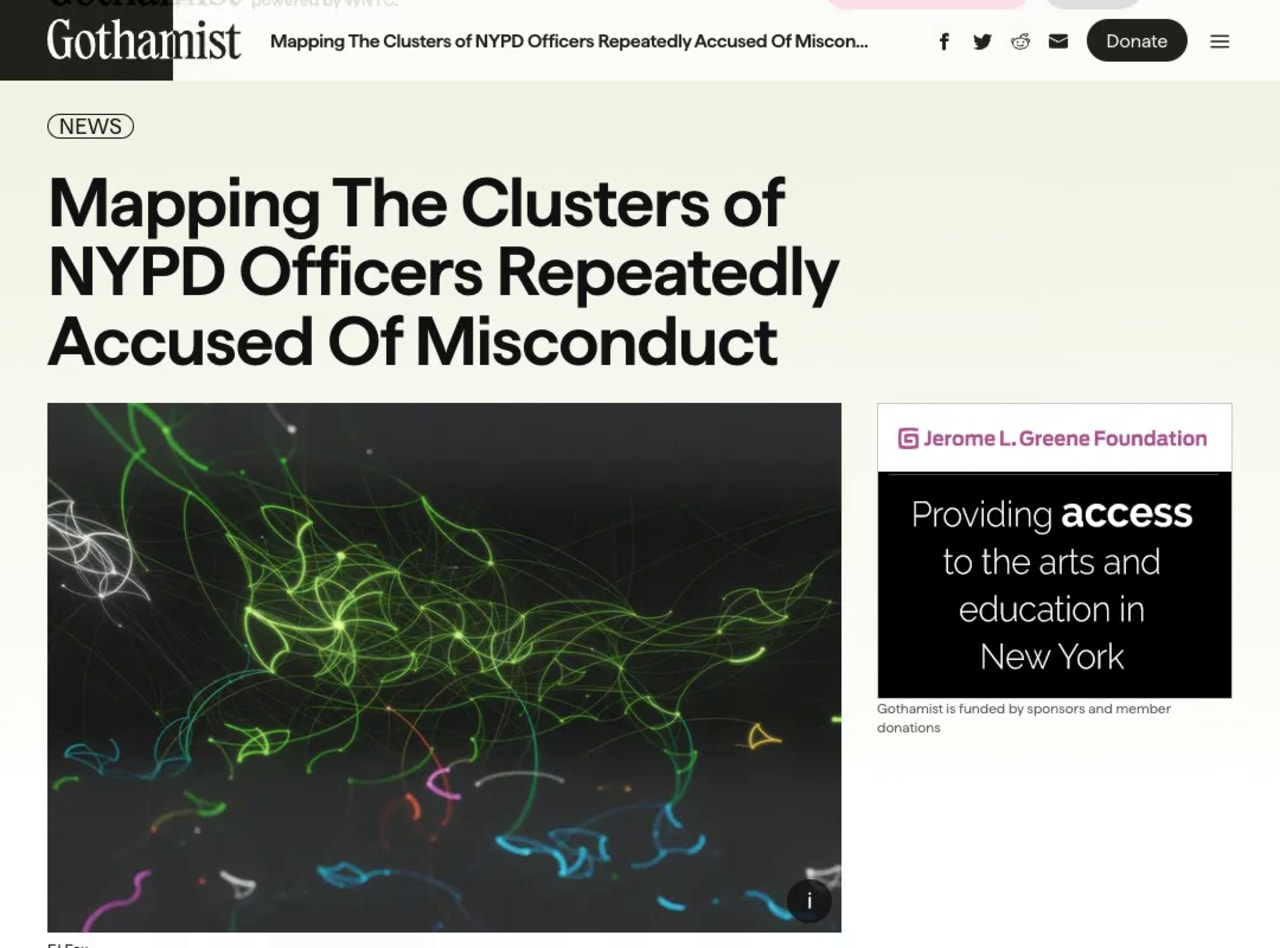
In 2021, WNYC/Gothamist got the NYPD's full civilian-complaint dataset through a FOIL request and handed it to me — every complaint and every officer since 2000, including officers named only as witnesses and complaints the CCRB never substantiated. Noisier than the data ProPublica had published a year earlier, but for mapping a network that noise is the signal: being named on a complaint alongside another officer, even an unfounded one, means the two of them interacted in a way the public noticed.
Complaints are often the first and only warning that an officer is on a course of escalating violence. Derek Chauvin had at least 22 complaints across 19 years before he killed George Floyd; the officer who choked Eric Garner had 7. Nothing disrupted either pattern.
So I built the network — 29,915 officer nodes, 159,671 relationships, in Neo4j (with a lot of Cypher help from David Allen at Neo4j) and laid out in Gephi (love-hate relationship, but unrivaled for networks). Two officers get a link — a CO_OCCURANCE — when they appear on the same complaint, weighted by how many they share: three complaints together, weight 3. I filtered out everything the CCRB marked exonerated or unfounded first, and only labeled an officer by name if they'd had a complaint substantiated — a caution I was told lawyers would appreciate. Everyone else stays an anonymous ID.
One sign it was working: when I ran community detection, the clusters mirrored real NYPD precincts — officers appear on complaints with the officers they actually work beside.
Then the big nodes surfaced — Martinez, Radoncic, Grieco — officers co-appearing on complaint after complaint. When Gothamist reporter George Joseph took those names to the street and interviewed victims, the graph held up: the central nodes were acting as catalysts in real life. One man described a big node, Adnan Radoncic, sparking a group assault — "As soon as he grabbed me, all the officers was hands on. It's like they just followed his lead." Math and reality matched up.
I documented every query and every decision so anyone could rebuild this for their own police department: the full methodology write-up →